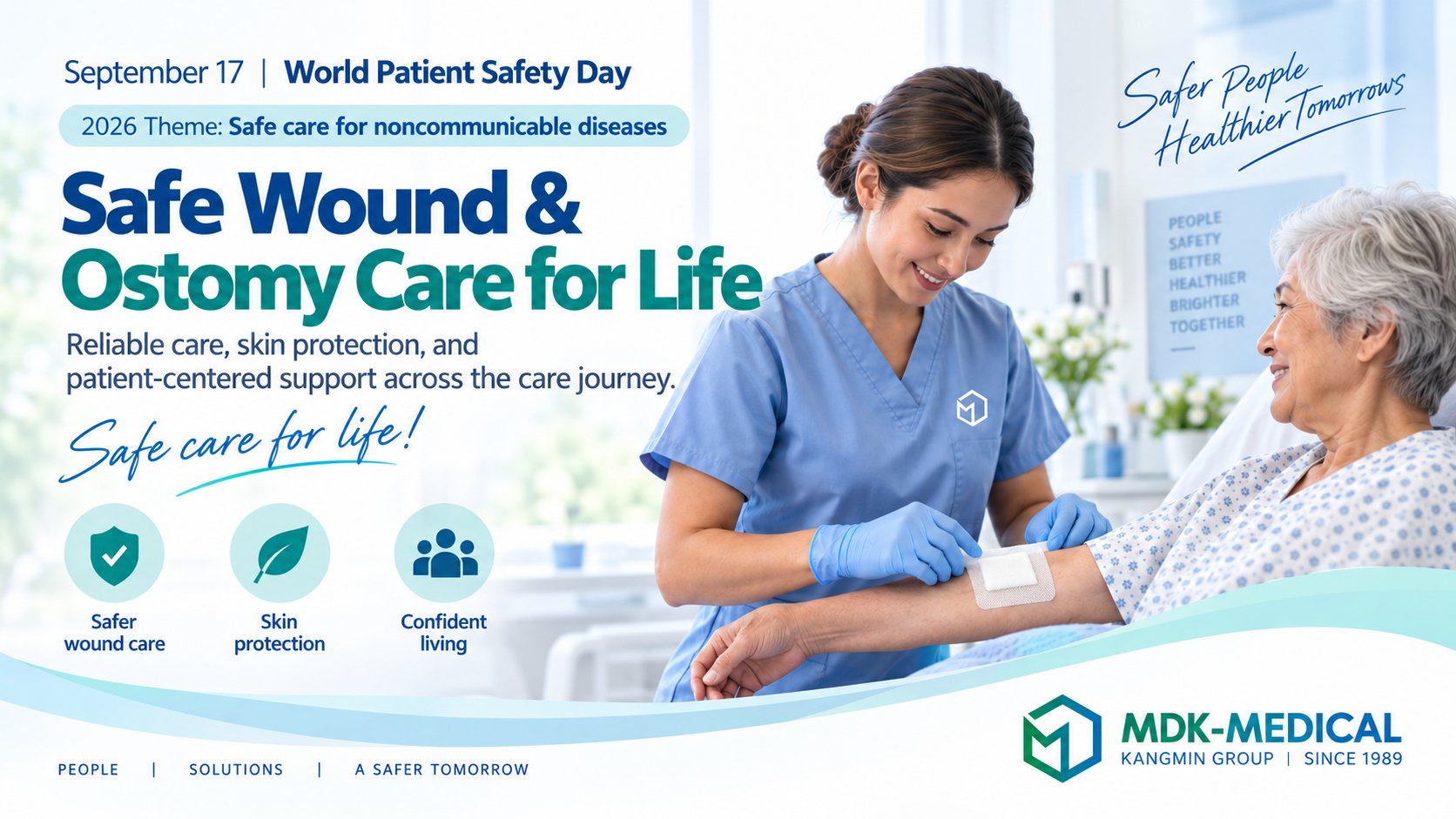
September 17, 2026
Patient safety is not limited to a single procedure or hospital visit.
For people who require ongoing treatment, wound management, rehabilitation, ostomy management or other forms of long-term care, safety must continue throughout the entire healthcare journey.
World Patient Safety Day 2026 focuses on “Safe care for noncommunicable diseases”, under the WHO slogan “Safe care for life!”
WHO emphasizes that people living with noncommunicable diseases often require repeated care across different settings and over long periods. Safety risks can therefore arise during prevention, diagnosis, treatment, long-term management and self-care.
For MDK Medical, this message is closely aligned with a fundamental principle of wound and ostomy care:
Safe care should continue beyond the procedure and throughout everyday life.
What Is World Patient Safety Day 2026?
World Patient Safety Day is observed annually on September 17 to increase awareness of patient safety and encourage action to reduce avoidable harm in healthcare.
The 2026 campaign focuses on people living with noncommunicable diseases, such as cardiovascular diseases, cancers, diabetes and chronic respiratory diseases.
WHO reports that approximately 1 in 10 patients globally experiences harm during healthcare, with around half of that harm considered preventable. People receiving long-term care may face additional risks because of repeated treatment, complex care pathways and frequent interaction with healthcare systems.
This makes continuity, communication, appropriate product use and patient participation particularly important.
Why Is Safe Wound Care Important?
Wound management is not simply about covering a wound.
Different wound conditions may require different approaches to protection, moisture management, exudate management, surrounding-skin protection and dressing changes.
Appropriate wound-care decisions should therefore consider factors such as the wound condition, intended product use, exudate level, surrounding skin, required wear characteristics and professional clinical assessment.
There is no single dressing that is appropriate for every wound.
Depending on the clinical situation and intended application, healthcare professionals may select from different wound-care technologies, including:
Foam dressings for appropriate wound-management applications where absorption and cushioning characteristics may be required.
Hydrocolloid dressings for selected applications where a protective, moisture-supporting environment is appropriate.
Transparent film dressings for applications requiring a thin and flexible protective barrier with visibility.
Silicone wound-care products for selected applications where gentle wound or skin contact characteristics are required.
Non-woven dressings and fixation products for routine medical, dressing and fixation applications.
Product selection should always be based on the wound condition, intended purpose, instructions for use and professional guidance where necessary.
How Does Wound Care Relate to Long-Term Patient Safety?
Some wounds require repeated assessment and dressing changes over extended periods.
For these patients, safety depends not only on the first dressing applied but on maintaining appropriate care throughout the wound-management process.
Important considerations can include consistent dressing practices, surrounding-skin protection, appropriate change frequency, monitoring of the wound, patient and caregiver education and timely professional assessment when the wound condition changes.
The principle aligns with WHO's 2026 message that patient safety risks need to be managed across the continuum of care, not only during isolated clinical encounters.
Why Is Ostomy Care Part of Patient-Centered Safety?
Ostomy care extends beyond surgery and into everyday life.
People living with an ostomy may need to manage pouching systems, peristomal skin, product changes and daily routines independently or with support from healthcare professionals and caregivers.
Safe and effective ostomy management therefore involves more than choosing a pouch.
Relevant considerations can include:
Secure fit. An appropriate fit can help support reliable day-to-day use.
Peristomal skin protection. The skin surrounding the stoma requires appropriate management and monitoring.
Comfort. Ostomy products should support the user's daily activities according to their intended design and application.
Appropriate product selection. Different users may require different pouching systems, barriers, accessories and configurations.
Patient education and participation. Patients need practical information to understand their products and participate confidently in their own care.
WHO's World Patient Safety Day 2026 campaign specifically emphasizes that people living with long-term conditions should be partners in safe care, and that meaningful engagement and health literacy can contribute to safer, higher-quality care.
What Does Patient-Centered Wound and Ostomy Care Mean?
Patient-centered care means considering more than the technical characteristics of a medical product.
For wound and ostomy care, it can involve understanding the patient's clinical needs, skin condition, care environment, daily routine, ability to manage the product, comfort requirements and professional care plan.
For manufacturers and distributors, patient-centered product development also means considering how products will actually be used in hospitals, clinics, long-term care environments and homes.
That can affect product configuration, materials, sizes, packaging, instructions for use and market-specific requirements.
MDK Medical Wound Care Solutions
MDK Medical focuses on wound care and ostomy care solutions for international healthcare markets.
The wound-care portfolio includes different dressing technologies and configurations for different intended applications, including:
- hydrocolloid dressings
- foam dressings
- silicone wound-care products
- transparent film dressings
- non-woven dressings
- fixation products
- related wound-care solutions
For international distributors and healthcare partners, MDK Medical also supports product selection, specification development, packaging customization, private-label cooperation and OEM/ODM projects according to project requirements.
MDK Medical Ostomy Care Solutions
MDK Medical's ostomy-care portfolio includes pouching systems and related accessories designed for different market and user requirements.
Depending on product configuration and project requirements, solution areas include:
- one-piece ostomy pouches
- two-piece ostomy systems
- closed and drainable pouch configurations
- urostomy-related products
- ostomy barrier products
- ostomy accessories
- skin-care and supporting products
Product specifications and configurations should always be selected according to intended use, applicable regulatory requirements and actual market needs.
Why Product Selection Matters for Distributors and Healthcare Partners
For distributors, importers and healthcare organizations, developing a wound or ostomy portfolio involves more than selecting individual SKUs.
Important factors can include clinical application, user needs, material and construction, product sizes, packaging format, regulatory documentation, local market requirements and supply reliability.
MDK Medical works with international partners to evaluate these requirements and develop suitable wound-care and ostomy-care solutions.
This B2B approach is particularly important in medical devices, where product specifications, intended use and regulatory requirements should remain aligned throughout product development and market introduction.
Frequently Asked Questions
What is the theme of World Patient Safety Day 2026?
The 2026 WHO theme is “Safe care for noncommunicable diseases”, with the slogan “Safe care for life!” It focuses on reducing preventable harm throughout the long-term care journey.
Why is wound care important for patient safety?
Appropriate wound care can support wound protection, surrounding-skin management and continuity of care. Dressing selection should be based on wound condition, intended use and professional assessment where appropriate.
Are all wound dressings suitable for every wound?
No. Different wound dressings are designed for different applications and wound conditions. Product selection should consider wound characteristics, intended use and professional guidance.
Why is skin protection important in ostomy care?
Peristomal skin is continually exposed to the demands of pouching and product changes. Appropriate fit, product selection and skin-care practices are therefore important components of ongoing ostomy management.
What wound-care products does MDK Medical manufacture?
MDK Medical's wound-care portfolio includes hydrocolloid, foam, silicone, transparent film and non-woven dressing technologies as well as related wound-care and fixation products.
What ostomy products does MDK Medical provide?
MDK Medical provides one-piece and two-piece ostomy systems, different pouch configurations and related ostomy-care accessories for international markets.
Does MDK Medical support OEM or private-label projects?
MDK Medical works with international distributors and healthcare partners on suitable product configurations, packaging customization, private-label and OEM/ODM projects according to product and market requirements.
Safe Care Beyond the Hospital
Patient safety does not end when a procedure is completed or a patient leaves a hospital.
For people managing wounds, ostomies or long-term health conditions, safe care continues through repeated treatment, product use, self-care and everyday life.
World Patient Safety Day 2026 provides an opportunity for healthcare professionals, manufacturers, distributors, caregivers and patients to reinforce a shared goal:
Safer Wound Care. Better Healing.
Safe Ostomy Care. Confident Living.
Safe Care for Life.
MDK-MEDICAL | Kangmin Group | Since 1989
Call to Action
Looking for wound-care or ostomy-care products for your market?
Contact MDK Medical to discuss wound dressings, ostomy products, specifications, packaging customization, private-label requirements and OEM/ODM cooperation.
Sources
- World Health Organization — World Patient Safety Day 2026: https://www.who.int/campaigns/world-patient-safety-day/2026
- WHO campaign event page: https://www.who.int/news-room/events/detail/2026/09/17/default-calendar/world-patient-safety-day--17-september-2026---noncommunicable-diseases


