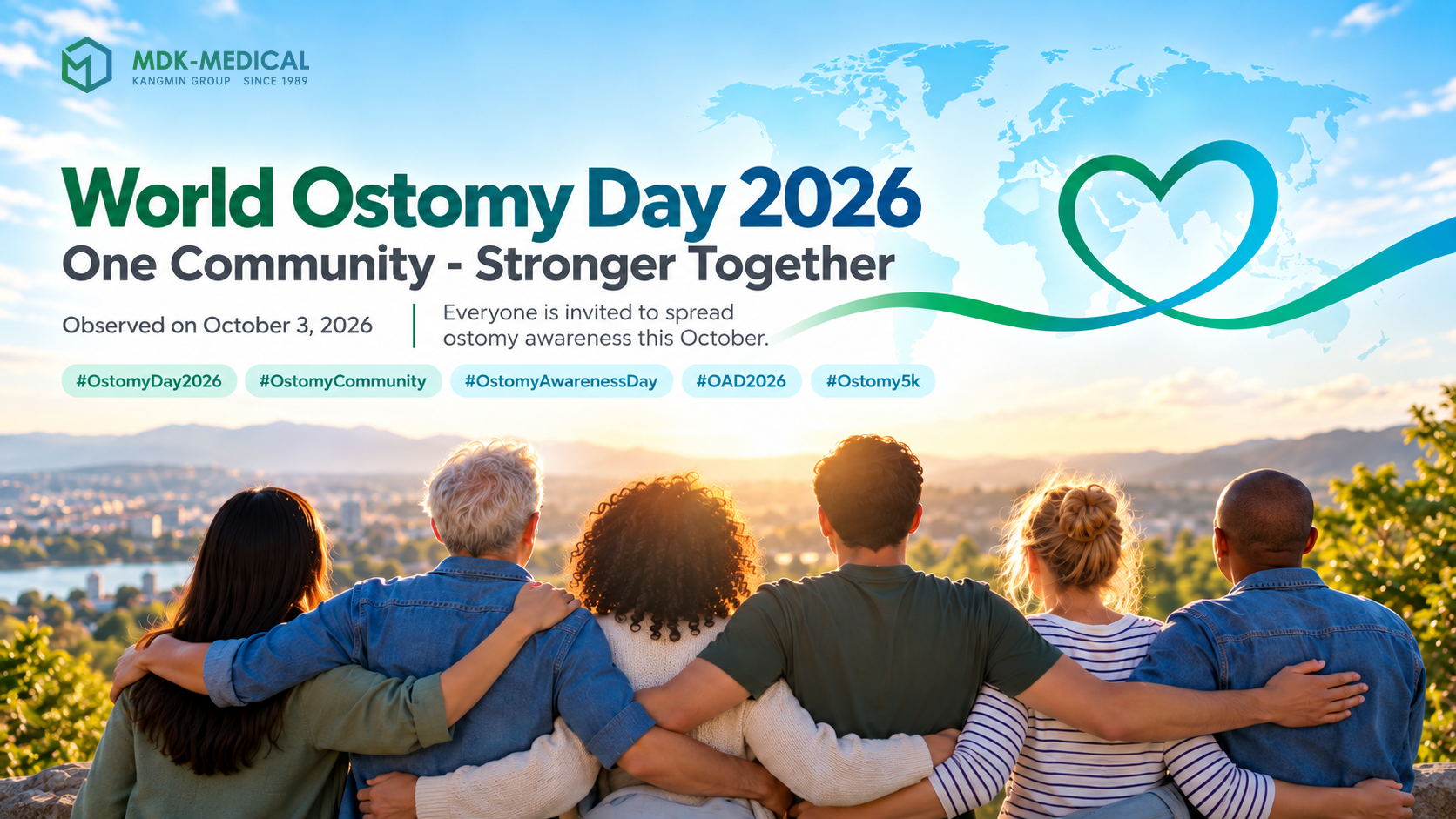
World Ostomy Day was observed on October 3, 2026, highlighting the importance of understanding, dignity and community. For care providers and supply partners, awareness is also a reminder to make reliable ostomy care options easier to access.
October 25, 2026 | Health Awareness
Table of Contents
1. What Is World Ostomy Day?
2. Why Ostomy Awareness Matters
3. What Thoughtful Ostomy Product Programs Require
4. Supporting Custom Ostomy Programs
5. Frequently Asked Questions
6. Conclusion
7. Related Resources
What Is World Ostomy Day?
World Ostomy Day was observed on October 3, 2026. The occasion encourages understanding of life with an ostomy and recognizes the people, care professionals and communities who help make day-to-day experiences more supported and inclusive.
The 2026 theme from the United Ostomy Associations of America (UOAA) is “One Community - Stronger Together”. Its invitation is simple: “Everyone is invited to spread ostomy awareness this October.” Together, these messages place connection and respect at the center of the conversation, rather than defining individuals by a medical condition.
Why Ostomy Awareness Matters
Ostomy awareness begins with listening. People living with an ostomy may have different routines, priorities and preferences; their experiences should be represented without stereotypes, pity or assumptions. Accessible information and respectful conversations help friends, families and care teams respond with greater understanding.
Awareness also has a practical dimension for the professionals who support access to supplies. Distributors, importers, hospital suppliers and procurement teams need to understand the categories they source, the questions care providers ask and the importance of consistent communication across a supply program. Responsible product selection supports informed professional assessment; marketing material should never replace clinical guidance.
What Thoughtful Ostomy Product Programs Require
Ostomy supply programs commonly span one-piece and two-piece ostomy pouches, skin barriers, activated-carbon filters and ostomy accessories. These are broad categories, not a claim that every configuration suits every user or setting.
For a B2B buyer, the conversation extends beyond an item on a catalogue page. Product structure, compatibility considerations, materials, packaging presentation and documentation requirements all need to be discussed against the intended market and customer brief. Requests should be assessed individually rather than answered with unsupported assumptions about specifications, regulatory status or performance.
A useful starting point is to clarify the intended product category, distribution model and preferred private-label presentation. From there, buyers and manufacturing partners can establish a product-development conversation based on actual requirements.
Supporting Custom Ostomy Programs
MDK Medical, part of Kangmin Group in Xinxiang, Henan, China, has a manufacturing history dating to 1989 and focuses on ostomy and wound care OEM/ODM customization and manufacturing. Its approach is to work with partners at the development stage, not simply present a fixed catalogue.
At the capability level, collaboration may involve formulation-level customisation, rapid sampling and iteration, adjustability of specifications, structure and packaging, and the option to discuss finished-goods or semi-finished supply. The appropriate scope is determined by the buyer's brief and subsequent technical review; no particular product configuration or lead time is implied here.
For a distributor developing a house brand or a procurement team assessing a new line, this kind of collaboration can make the decision process more structured. The goal is to act as “an extension of your R&D team”, with product options evaluated together rather than reduced to a price comparison.
Frequently Asked Questions
When was World Ostomy Day observed in 2026?
World Ostomy Day was observed on October 3, 2026.
What was the 2026 awareness theme?
The UOAA's 2026 theme is “One Community - Stronger Together,” emphasizing shared understanding and community support.
Which ostomy product categories can distributors explore?
A starting discussion may cover one-piece and two-piece ostomy pouches, skin barriers, activated-carbon filters and ostomy accessories. Available configurations require confirmation for each project.
Can a private-label buyer discuss customisation?
Yes. A buyer can share its target market, product concept and packaging requirements for an individual feasibility review. No unverified specification or commercial commitment should be assumed.
Is this article a guide to clinical ostomy care?
No. It is an awareness and B2B supply-program overview. Individual care decisions belong with qualified healthcare professionals.
Conclusion
Awareness is most meaningful when it leads to respectful conversations and better-informed collaboration. The 2026 message of shared community extends to everyone supporting access to appropriate ostomy care options, including the professionals who plan, source and evaluate supply programs.
For a distribution, OEM/ODM or private-label discussion, please contact us.
Talk to Our Expert: contact us for an OEM/ODM or distribution inquiry.
Published: 2026-10-25
Updated: 2026-10-26


